More than 30 free picture books for parents, and why we made them for the child who can't sit still
Our small nonprofit writes picture books about the hard questions of growing up, and we keep them free. Each one is adapted for children with ADHD. Here is what we learned about making a book a wiggly child will stay with.
Sooner or later every child asks a question that stops a parent cold. Why do people die? Why is that man shouting? Why can't I hug everyone? Most of us answer the way our parents did, with a pause and a change of subject. I wanted something better for those moments, so I started a small nonprofit to make it.
The ABCs of Growing Up Foundation writes picture books for children about the parts of growing up that are hard to explain: fear, anger, sadness, a fight with a friend, getting lost in a crowd, a stranger at the playground, your body being your own. Our series has now passed 30 books, and 24 of them are on Whyia's World for any family to read today, free.
One girl who can turn into anything
Every book has the same heroine. Whyia is an eight-year-old girl who can turn into anything: a cloud, a tree, an owl, a dolphin. She says the magic words, "Look at me, here I stand!", becomes something else for a while, and comes back knowing a little more about feelings and the world. Then she shares it with your child.
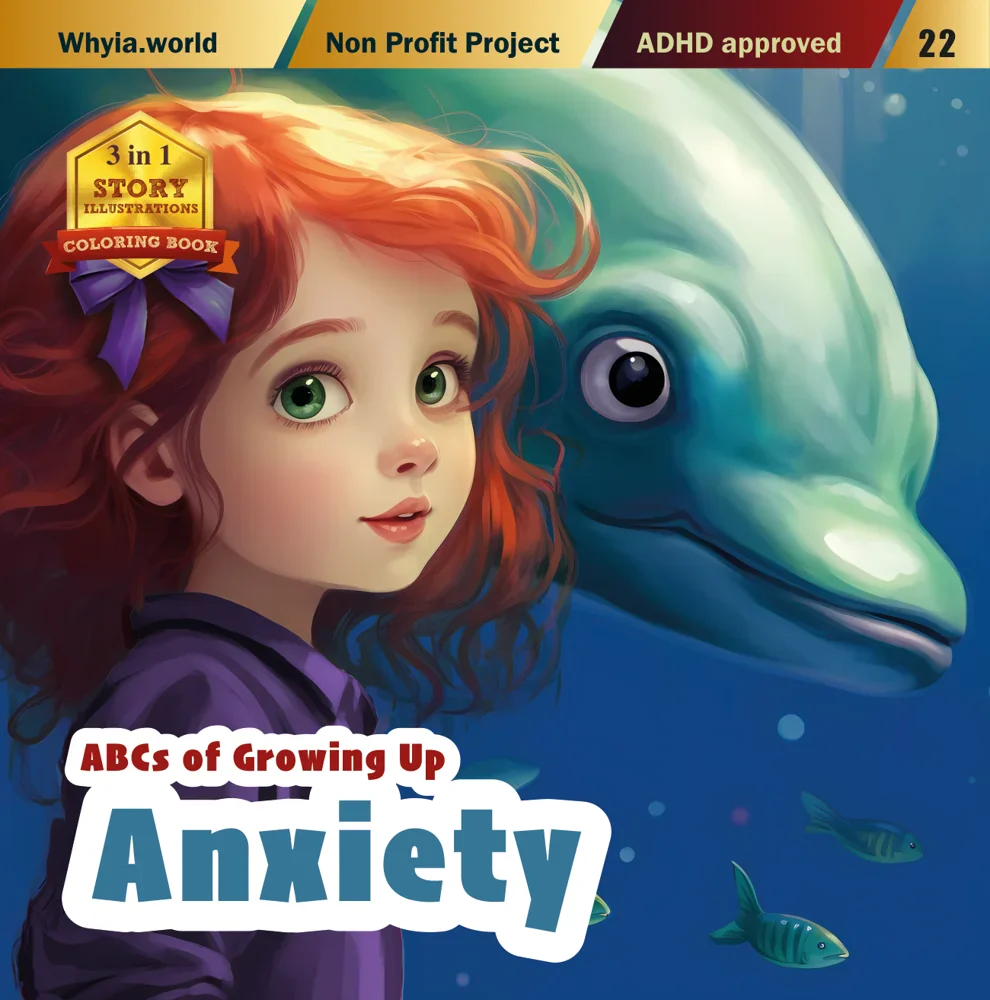
Each book starts with a real question a real child asked. The books happen on one island, and a child explores it one place at a time: the sky, the river, the zoo, the town, the farm, the park, the beach. In Anxiety, the book on this page, Whyia is on a beach in Florida, bored and missing her friends, and too nervous to walk over to the children building a sand castle. So she becomes a small dolphin and asks a grown dolphin what to say.
Each book is three in one: a story, the pictures that tell it, and pages to color. When we wrote about our team in September, each title took about four weeks, more than 200 reviews and more than 40 illustrations drawn for that book alone.
Made for the child who can't sit still
Every one of these books is adapted for children with ADHD. I want to say what that means, because it is not a label on the cover. It is how the book is built.
A lot of parents open a book with an active child and give up after two pages. The child slides off the sofa, rolls across the rug, comes back for one picture and is gone again, and the parent decides reading together is not for them. It is. A busy body can still have a listening brain. Asking a child to sit perfectly still uses up the attention on sitting, and leaves little for the story.
So our books are made for short sessions, a lot of talking and a lot of pictures. Our guide for parents of active children puts it in one line: five good minutes a day are worth more than one hard half hour. Let the child move, hold the book and turn the pages. Give them a job: the page turner, the one who finds Whyia on every page, the one who makes the rain and the thunder. Stop while it is still fun, and read the same book again tomorrow.
The question on every page, "What do you think Whyia will turn into next?", is there on purpose. It turns listening into a conversation, and a conversation holds an active mind far better than a lecture does.
More than books
Around the books we built the things a child asks for after the last page. There are games with no timers, no ads, and nobody who loses. There are jigsaw puzzles with pieces as big as little hands need, and pages to color right on the screen.
There are masks to print: a dolphin, an owl, a kitten, a puppy, a sloth. Print one on thick paper, color it, cut it out, and when Whyia changes in the story, your child changes too. Nothing works better for a child who learns with the whole body.
For grown-ups there are 41 short guides, each on one hard feeling or moment: tantrums and meltdowns, bedtime, siblings, picky eating, fear of the dark, saying goodbye at drop-off. Each one ends with a book to read together. They are written by a volunteer team of 17 parents who are psychologists, from four countries.
Why free
A family that needs words for a hard conversation needs them tonight, not after a purchase. A child with ADHD whose parents are already stretched thin should not have to wait for a library hold. So the books stay free for everyone.
I think about 501c3.help the same way. Most nonprofits I meet are small, and they do something useful for people who cannot pay much for it. Free is not the easy part. It is the point.
What you can do
If you are a parent or a grandparent, pick a book by the feeling your child is having this week and read it tonight, five minutes, with your child on the floor if that is where they want to be. If you run a nonprofit that works with families, a reading program, a preschool, a shelter, a pediatric clinic, the books are free to read with the children you serve. Put a link to them where your families will find it.
And if your child asks Whyia a question we have not answered yet, tell us. That is where the next book comes from.
About this column
Founder's Notes is the column of Dima Bocha, founder of 501c3.help, in The Nonprofit Herald.
Found an error? Write to [email protected] and we will correct it.