What the 2026 election changes for nonprofits, from Washington to your statehouse
Democrats won the House, the Senate and most governorships, and nine statehouse chambers changed hands. I won't tell you who should have won. I want to show where the money and the rules nonprofits live on are likely to move next.
I won't tell you who should have won. The nonprofits we work with run food banks, churches, youth leagues and veterans' groups, in counties that voted every way there is, and a 501(c)(3) stays out of campaigns for good reason. But an election decides who writes the budgets, the grant rules and the contracts so many of you depend on. That part is our business, and on Tuesday a lot of it moved.
What happened
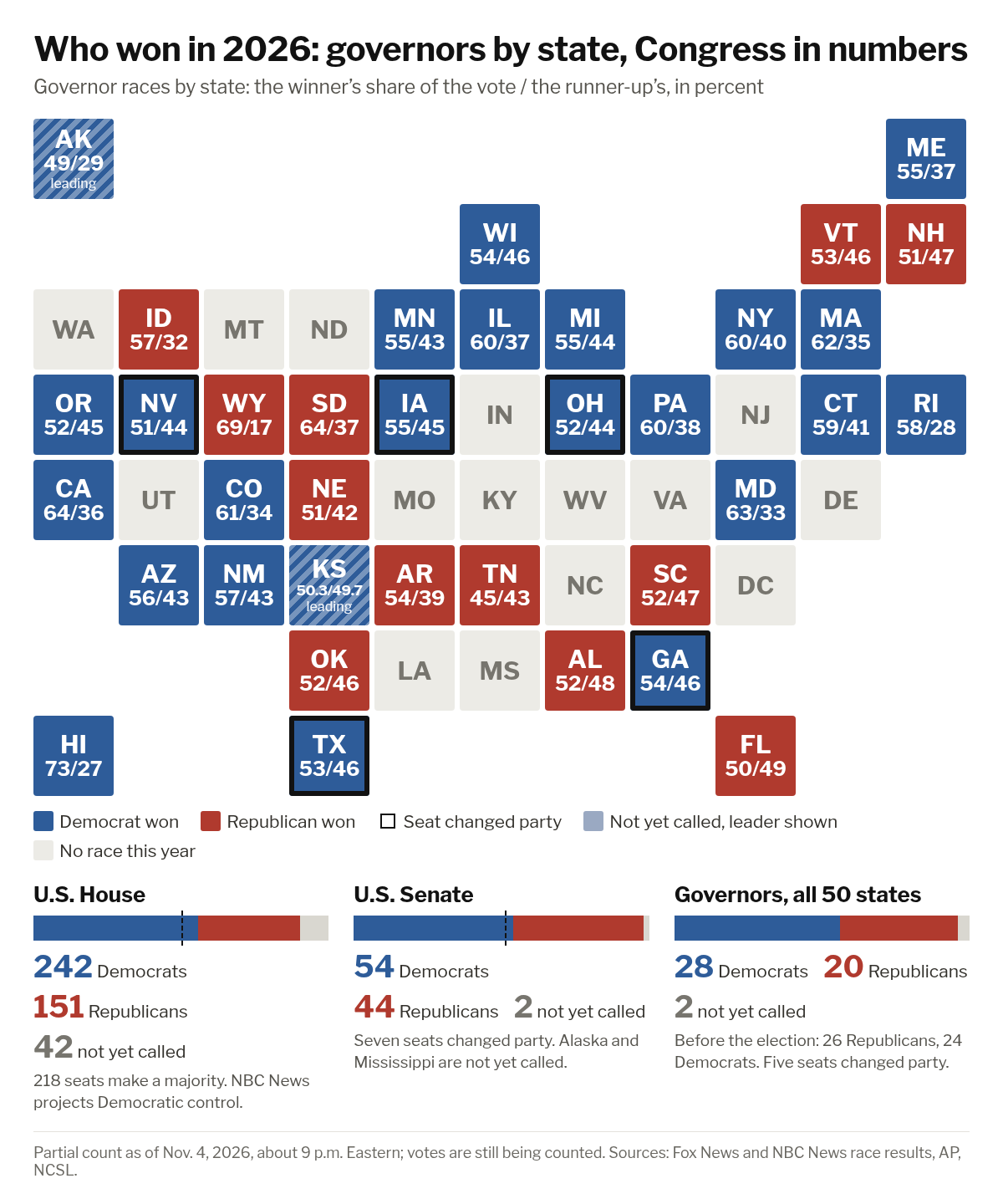
Votes are still being counted, so every number here is as of Wednesday evening, Nov. 4. NBC News projects that Democrats win the House, with 242 seats called for them and 151 for Republicans; 218 make a majority. In the Senate, NBC counts 54 Democrats and 44 Republicans after seven seats changed party, with Alaska and Mississippi still too close to call.
Thirty-six states elected a governor. Democrats took five offices from Republicans: Georgia, Iowa, Nevada, Ohio and Texas, where Gina Hinojosa unseated Greg Abbott. Kansas and Alaska are not called yet. By the count of the National Conference of State Legislatures, Democrats now hold 28 governorships and Republicans 20, after Republicans came into Election Day ahead 26 to 24.
The statehouses moved too. NCSL lists nine legislative chambers that flipped to Democrats, among them the Texas House, for the first time since 2002, and the Pennsylvania Senate, for the first time since before 1994. Michigan, Minnesota, Nevada, Pennsylvania and Wisconsin now have one party holding the governor's office and both chambers. Georgia, Iowa, New Hampshire, Ohio and Texas no longer do.
Washington: a split government, and a deadline first
From January, a Republican president will work with a Democratic Congress. Before that, the current Congress has to fund the government past Dec. 11, when the stopgap runs out. For nonprofits on federal grants, one item in that fight matters more than the headlines suggest: a proposed change to the federal grant rules that would make it easier for an agency to change or end a grant in the middle of a project. Independent Sector reports that the stopgap holds it off only until Dec. 11.
After January I expect a lot of noise and few new laws. Democratic leaders have promised to restore funding for Medicaid and food assistance, and the president has said he will veto what they send him. In that standoff, the decisions that reach a nonprofit first will come from the agencies and the IRS, not from Congress. The Treasury and IRS plan for the year ahead includes guidance on the Johnson Amendment, on donor-advised funds and on reporting by fiscally sponsored projects. Those deserve more of your attention than any floor vote.
In the states: some will move fast, some will bargain
Where one party now holds everything, budgets tend to move faster, and new priorities show up in the first session. Pennsylvania is the clearest case. The speaker of its House has promised a budget on time, and told reporters: "Come see us in June of 2027." When a state budget is late, the nonprofits on state contracts are the ones who wait to be paid, so this is a promise worth holding Harrisburg to.
Where one party lost its hold, the budget becomes a negotiation. Rob Sand in Iowa campaigned on ending the privatization of Medicaid, and Amy Acton in Ohio on protecting it from federal cuts; both will work with legislatures their party does not control. Gina Hinojosa ran against the Texas school voucher program and for more money for public schools, and her party won the Texas House but not the whole legislature. In Georgia, Keisha Lance Bottoms says fully funding pre-K and education comes first in her budget. Promises like these become line items only after a deal, and deals take time. If your organization lives on a state contract in one of these states, plan for a slow spring.
Two states run by Democrats elected governors who talk about results as much as money. In Minnesota, where the race was shaped by a fraud scandal in state social services programs, Amy Klobuchar pledged to audit state government and invest in technology to catch fraud. In California, Xavier Becerra told cities and counties that if they do not produce results on homelessness, he will not give them more money. Whatever you think of either, the message to the nonprofits that deliver those services is the same: the paperwork will count as much as the mission. Keep your outcome numbers and your books in a shape you could show an auditor tomorrow.
On the ballot
The measure I would read twice is in Montana. Voters approved I-194, which bars what it calls artificial persons from spending on candidates, parties and ballot issues starting Jan. 1, 2027, and it names nonprofits among them, along with unions, trade associations and companies. A 501(c)(3) already stays out of candidate races, but many charities spend on ballot measures that touch their work, and in Montana that may soon be closed to them. Its sponsor expects a court challenge. If you work in Montana, talk to a lawyer before you spend a dollar on a 2027 ballot question.
Some states limited what local governments can raise. Florida voters raised the homestead exemption and halved the cap on yearly assessment increases for other property; Jacksonville estimates the cost to the city at more than $300 million a year. North Carolina voters capped the income tax rate at 3.5% and told the legislature to cap property tax levies, and the chair of the Wake County commissioners has already warned of difficult decisions in 2027 for programs, service hours and public education. Counties and cities are where many nonprofits get their contracts and small grants, so in these states I would start the talk about next year's contract early.
Other states voted to keep or add money for work nonprofits do. Washington kept its tax on income over $1 million, and part of what it raises from 2028 goes to child care and early learning. Colorado passed Proposition NN, which sends money to schools and to children's programs the legislature will choose. Rhode Island approved a $120 million housing bond. South Dakota voters refused to let the state drop Medicaid expansion if federal funding falls. And California voters rejected Proposition 44, which would have told nonprofit community clinics how much of their revenue to spend on patient care; we covered that vote in the Herald.
What I would do this winter
Meet the new people before the budget is written. Most new governors and legislators take office in January, and the first budget proposals follow soon after. A 501(c)(3) may educate officials and, within limits, lobby them. What it may not do is campaign, and the campaign is over.
Read your contracts. Know which of your grants run through a state agency that will get a new head, when each one renews, and what you would do if a payment came three months late. Keep that much cash if you can.
Watch the agencies more than the speeches. In 2027 the rules that reach you first will come from grant offices and the IRS, and they will arrive with much less noise than a vote in Congress.
We will follow these changes in The Nonprofit Herald, state by state, and our state compliance guides will keep the filing rules current whoever holds office. If this election is about to change the work your organization does, I would like to hear from you.
About this column
Founder's Notes is the column of Dima Bocha, founder of 501c3.help, in The Nonprofit Herald.
Found an error? Write to [email protected] and we will correct it.