IRS asks court to dismiss Young America's Foundation challenge to the Schedule B donor list
The suit, filed in July in federal court in Washington, says the law requiring every 501(c)(3) to report its largest contributors to the IRS violates the First Amendment. The IRS answers that the reporting supports tax compliance. The requirement stays in force while the case goes on.
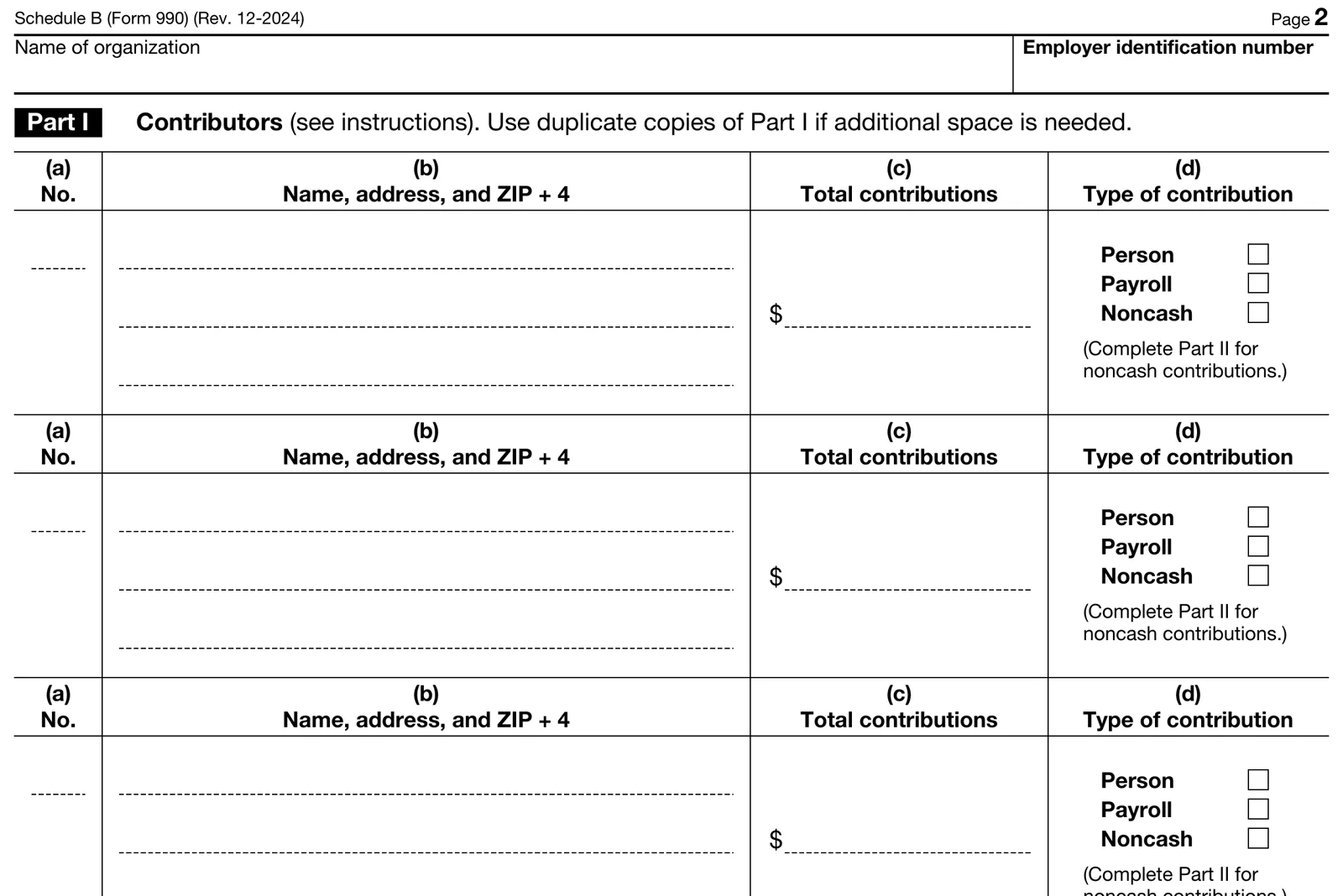
Washington. The Internal Revenue Service has asked a federal judge in Washington to dismiss a lawsuit by Young America's Foundation that challenges the requirement for charities to report their largest contributors to the agency, Bloomberg Tax reported on Oct. 15. According to Law360, the IRS told the court that the rule does not violate the First Amendment and that it promotes voluntary compliance through information reporting. Bloomberg Tax quoted the filing as saying there is "no constitutional right to a double tax subsidy."
The foundation, a 501(c)(3) in Reston, Va., that is led by Scott Walker, a former Republican governor of Wisconsin, filed the suit on July 13 in the U.S. District Court for the District of Columbia. It is represented by the Taxpayer Defense Center of the National Taxpayers Union Foundation. The defendants are the IRS, the Treasury Department, Treasury Secretary Scott Bessent and IRS Chief Executive Frank J. Bisignano. The reports did not give the date of the government's filing, and the court has not ruled.
What the suit asks
The case is about Section 6033(b)(5) of the Internal Revenue Code, which requires every 501(c)(3) that files an annual return to report "the names and addresses of all substantial contributors." Nonprofits do it on Schedule B of Form 990. Under the general rule, a filer lists anyone who gave $5,000 or more in the year. A public charity that meets the one third public support test lists a contributor only when that person's gifts were at least $5,000 and more than 2 percent of its total contributions. The names are left out of the copies the public may inspect.
The complaint asks the court to declare the requirement unconstitutional, both on its face and as applied to the foundation, and to bar its enforcement. It argues that under Americans for Prosperity Foundation v. Bonta, the 2021 Supreme Court decision that struck down California's demand for charities' donor lists, the federal rule fails exacting scrutiny, because the IRS examines few returns and can ask for names during an audit. It also says the IRS wrote to the foundation in December 2024 and October 2025 that its tax information was among the returns leaked by Charles Littlejohn, a former IRS contractor. The suit seeks no damages.
What it means for nonprofits
For now, nothing changes: Schedule B is still required, and a 501(c)(3) that meets either rule files it with its Form 990. Since a 2020 regulation, most other tax exempt organizations, such as 501(c)(4) social welfare groups, no longer report their contributors' names and addresses on it.
About this story
501c3.help wrote this story from the sources listed with it, not from material an organization sent. Our editors approved it on Oct. 17, 2026. Stories in The Nonprofit Herald are free, and nothing is asked in return. Editorial rules.
Found an error? Write to [email protected] and we will correct it.