A 50-state nonprofit compliance database opens to AI assistants, free and without registration
About 5,700 records each carry the statute behind them, the agency that issued it, the date they were last checked, and a label saying whether the rule is settled or still in question.
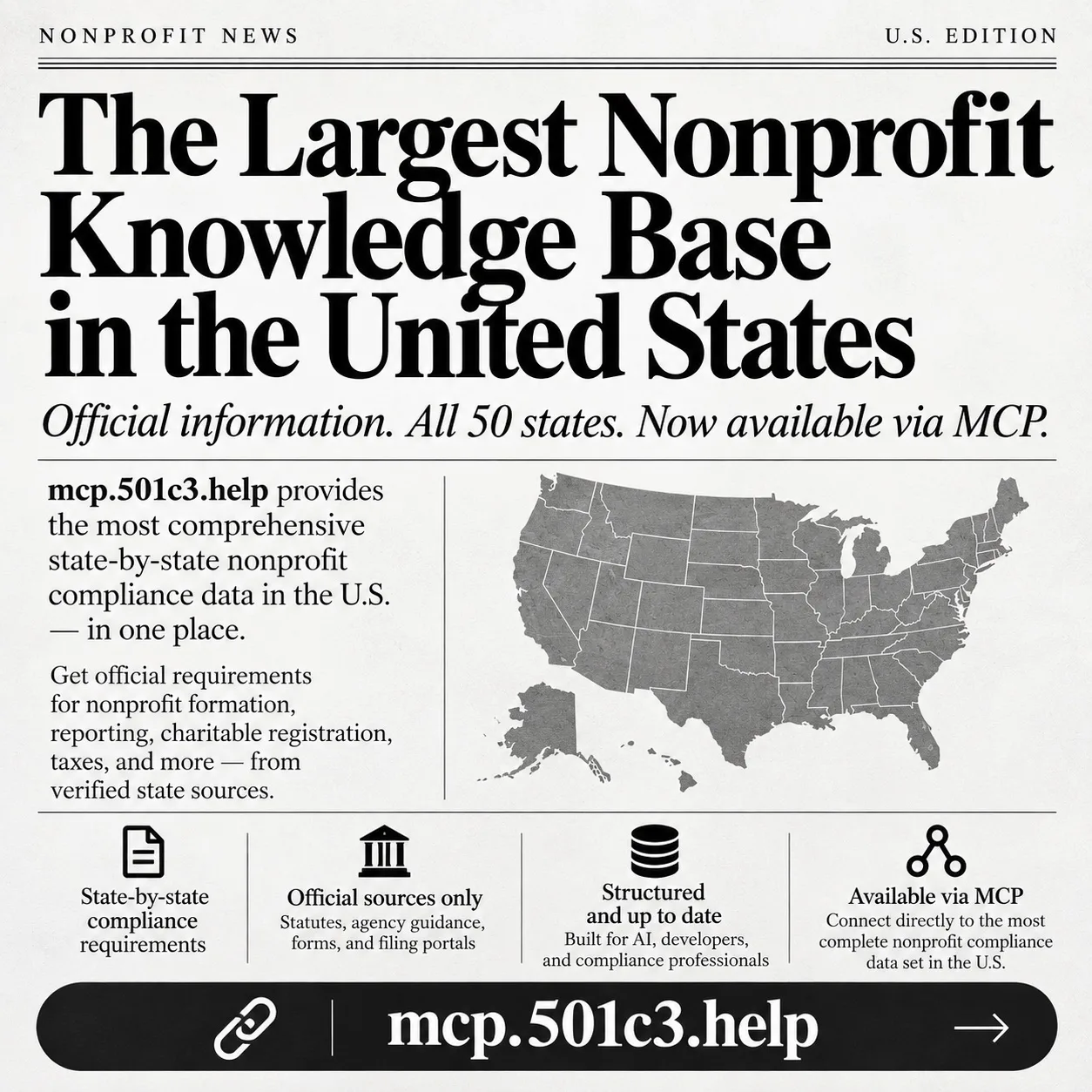
Sacramento. Nonprofit founders and the people who advise them can now put a compliance question to an AI assistant and get an answer drawn from a sourced record rather than from whatever the model remembers. The service opened on Oct. 1. Its records are published by 501c3.help, which also publishes the Herald.
It holds about 5,700 records covering all 50 states: incorporation, governance and registered agent duties, charitable solicitation registration, reporting, tax and employment. Every record names the statute it rests on, the agency that issued it, and the date someone last checked it.
How assistants reach it
Assistants reach it through the Model Context Protocol, the open standard assistants use to pull in outside data. Three requests are possible: the requirements for one state, one topic compared across as many as eight states, and every filing deadline in a single state. The server is listed in the protocol's official registry under the name help.501c3/compliance.
Use is capped rather than metered. Fifty requests a day without registering, 25 records in any one answer, and no way to pull the set down in bulk. A free key raises the daily figure to 1,000 and is requested by email.
Unsettled rules stay marked
Some questions the publisher has not been able to settle. A record where it has found a conflict, a gap or an ambiguity it has not resolved stays marked as unresolved, and the mark travels with the answer rather than being dropped on the way. The license calls showing a requirement while hiding that it is unsettled the one use of this data that can cause real harm, and forbids it.
The terms allow commercial use on three conditions: name the source, keep the verification status attached to the claim, and keep the citation with it. They do not allow copying the set as a whole, or a substantial part of it, to build a competing database. The license also states plainly that the underlying facts belong to nobody, and that only the wording and the arrangement are the publisher's.
The records are not legal or tax advice and do not come from any government agency. The license asks anyone acting on a record to check the cited source first, and to check it again before advising someone else.
About this story
501c3.help wrote this story from the sources listed with it, not from material an organization sent. Our editors approved it on Oct. 1, 2026. Stories in The Nonprofit Herald are free, and nothing is asked in return. Editorial rules.
Found an error? Write to [email protected] and we will correct it.